

The inenarrable Jacob Rees-Mogg has recently delivered himself of two back-to-back lectures addressed to the internet. The first one, where he lambasts the common people of Britain for their lack of “stiff upper lip” and warns that they must soon enroll in the military to fight Putler; the second, where he says that the English are “a mongrel people” and not “an Aryan master race.”
Put aside the merits. Surely political prudence from a former cabinet member should have advised Mr Rees-Mogg that telling ordinary people in quick succession that they must enroll to fight in a foreign war and also that they are racial inferiors is a combination of disastrous effect regardless of the merits of his case. Winston Churchill, a true aristocrat, whose life Mr Rees-Mogg may perhaps have studied, whose rhetoric famously did so much to rise the British people to their “finest hour,” did not feel a pressing need to chide them for being layabouts or run-of-the-mill genetic material.
Mr Rees-Mogg is primarily famous for gleefully embodying a self-conscious caricature of a British aristocrat.
This would merely be a charming British eccentricity if his caricature did not come with a darker side.
Here Mr Rees-Mogg embodies the worst part of the caricature, which is carefree contempt for one’s social inferiors.
And, to be absolutely clear about it, it is a caricature, and it is one made by an outsider.
The Strange Case of the Bourgeois Gentilhomme
Eton-bred peer though he may be, Mr Rees-Mogg is not, in fact, sociologically and culturally, an aristocrat in the sense I mean here. His father was made a peer because he was Editor of the Times. His family is a family of local clergymen and businessmen—nothing wrong with that, of course.
And, most importantly, the idea that aristocrats are usually contemptuous of their social inferiors is a caricature. For example, as Hippolyte Taine notes in his magisterial Origins of Contemporary France, during the French Revolution, the demographic least likely to participate in the events, to join the sans-culottes, etc. were the domestic workers of aristocrats, i.e., the people who had the most direct personal contact with aristocrats. In other words, the people who knew aristocrats best and most personally, did not hold grudges against them, and indeed often protected them at the risk of their own lives; and it was the people who did not know aristocrats personally who thought of them as contemptuous oppressors.
In The Red and the Black by Stendhal, the genius observer of social life (and, incidentally, not a monarchist), his ambitious striver protagonist Julien Sorel first works as a tutor for an aristocratic family and is full of resentment against them, until he then works for a liberal bourgeois family who have him dine at their table to witnesses how they treat their own servants like dirt, and realizes that the aristocrats’ formality and social distance was a mark of respect and not of contempt.
This brings us to an important point which Mr Rees-Mogg’s sad sorties highlight: the story of the liberal revolutions of the West is the story of bourgeois strivers trying to become aristocrats but only becoming grotesque caricatures of the aristocracy.
In France, this is the story of the French Revolution, overwhelmingly led by bourgeois strivers like Danton and Robespierre; the French Revolution proper is usually held by historians to end with the accession to power of Napoleon de Bonaparte, an aristocrat by birth1.
Incidentally, on the subject of names, in the intricate British class system, Mr Rees-Mogg’s double-barrelled surname, which is thought by many to be an aristocratic mark, is in fact usually a middle class affectation—aristocrats usually don’t feel the need to tack them on. For example, Marlborough descendant Winston Churchill’s full surname was Spencer-Churchill, but, like his father, he used Churchill2.
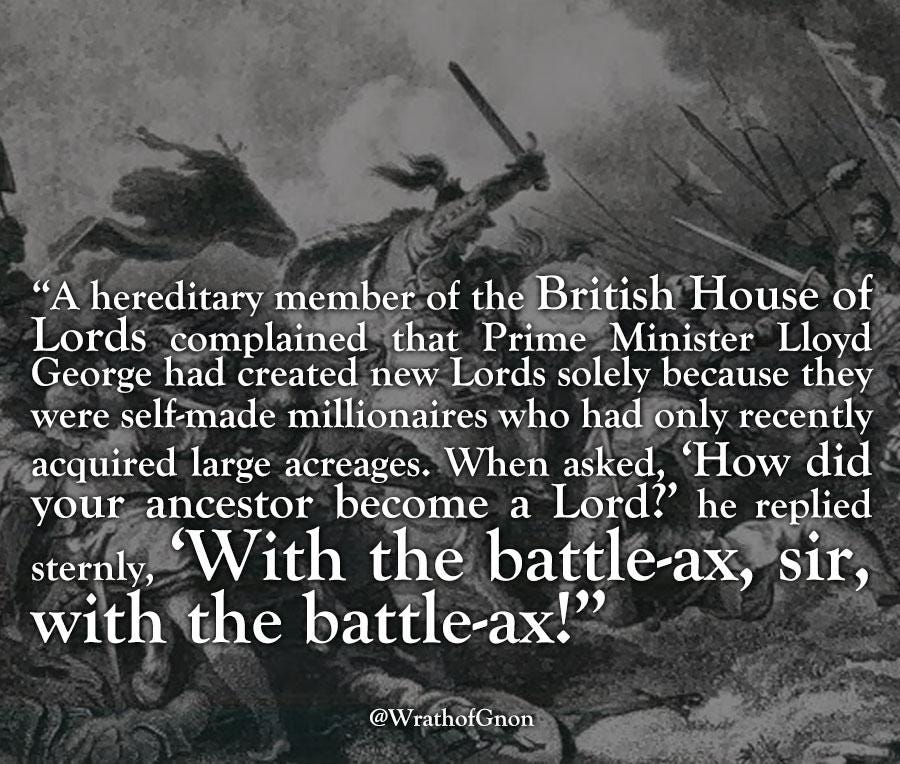
In Britain, this is the story of the Whigs versus the Tories, one which Britons like to think of as less violent, which is only true if one elides their own multiple revolutions, civil wars, and the Robespierre-like military tyranny of Cromwell. Even though many Whigs became peers and many Tories engaged in business, the sociological and historical basis of both camps is undeniable and was understood by all throughout: the Whigs were the globalized mercantile class of Britain, while the Tories were the land-owning descendants of the (largely, but not exclusively, French-descended) men who acquired their lands and titles with “the battle-ax, sir, the battle-ax.”
The final victory of the Whigs came with the repeal of the Corn Laws in 1846, agricultural tariffs, which was explicitly motivated at the time, not as we are usually told, by abstract concerns over economics and free trade, but by the desire to destroy the economic basis of the power of the land-owning Tories. From that point on, the Tory Party really became slow-motion Whigs, a phenomenon which a young Benjamin Disraeli lampooned as a writer, before an old Benjamin Disraeli embodied it as prime minister, refusing to use his majority to reinstate the Corn Laws or otherwise roll back most of the liberal reforms of his arch-nemesis Gladstone.
And Mr. Rees-Mogg, though he belongs to a party which is called Tory, is very much a Whig. His occupation before entering politics was running a hedge fund, the mercantile bourgeois occupation par excellence for our age; his resume is much closer to that of, say, uber-meritocrat Rishi Sunak than to aristocrat Boris Johnson’s, and he holds Whig beliefs the issues that truly separate Whig from Tory: globalization, free trade, immigration. Whig or Tory is more a spiritual reality than belonging to this or that party (indeed Churchill, definitely a Tory to his bones, was infamously for a long time a member of the Liberal (i.e., Whig) Party; another famous Tory Liberal was Edmund Burke).
No doubt aristocratic society had many faults (indeed, it lost), but it’s the bourgeoisie that won so firing cannonballs at aristocrats in our day and age is merely an affectation.
The Secret Downside of Meritocracy
And so, as I say, bourgeois contempt for one’s social inferior is part of their caricature of aristocrats. The reason why they believe this caricature is projection, and the reason why they feel the need to be this way is that because they acquired their social status through merit, that is to say, through their own actions, they feel insecure in this status, and so they feel threatened by their social inferiors, who after all may just as easily become richer and more powerful through merit, and therefore they feel a need to pre-emptively hold them down. As I say, aristocrats do not feel this need, and this is because their status comes from who they are, and therefore do not feel threatened (indeed, if French aristocrats had felt this way about the common people, the French Revolution would never have happened!). In Western culture, the ur-aristocratic moment is the famous passage in The Odyssey where Odysseus, although shipwrecked and so shorn of everything that he is literally naked, is nevertheless immediately identified by his peers as a nobleman simply on account of the way he comports himself. Outsiders think that what makes an aristocrat is things like owning a castle and having a baroque name and sneering at the poors, but in the internal self-consciousness of the European aristocracy, what makes an aristocrat is an inner quality of the soul that comes from “breeding,” that is to say, a combination of birth and education and training into the right aristocratic traits (what Greek aristocrat Plato, and Aristotle, commoner but tutor of the King of Macedon’s son, called virtue).
The French Aristocracy's Secret Selective Breeding Project

A very interesting phenomenon happened a few weeks ago: an obscure doctoral thesis in philosophy, self-published by its author, one Costin Alamariu, went viral and became a best-seller on Amazon.
To be clear, meritocracy has many virtues, but no human institution is perfect, and this is the flaw of meritocracy, which is that it is inherently a regime of social insecurity. And the other issue of meritocracy, is that every meritocrat cheats a little bit. I am not talking about criminal fraud or anything like this, but the little shortcuts that everyone takes to “work the system.” No matter what he tells others, the meritocrat thinks: “Did I really get into Oxford because of merit, or was there an element of luck?”; “Did I really sell my startup because I was the best, or was there an element of luck?” And, of course, there’s always at least an element of luck, or at any rate the meritocrat cannot ever fully convince himself that there is not. But what the bourgeois tremulously fears is luck, the aristocrat gratefully accepts as Providence.
And so the bourgeois despises the common man because of merit, but he also resents the aristocrat because the aristocrat doesn’t have merit. What the bourgeois must work for, the aristocrat has received from birth. The bourgeois feels that this is an injustice and that therefore he must replace the aristocrat. But he is also jealous of the aristocrat, his culture, his education, the whole trappings of the aristocracy, and perhaps also this inner lack of social insecurity I have mentioned, and therefore he wants to become the aristocrat.
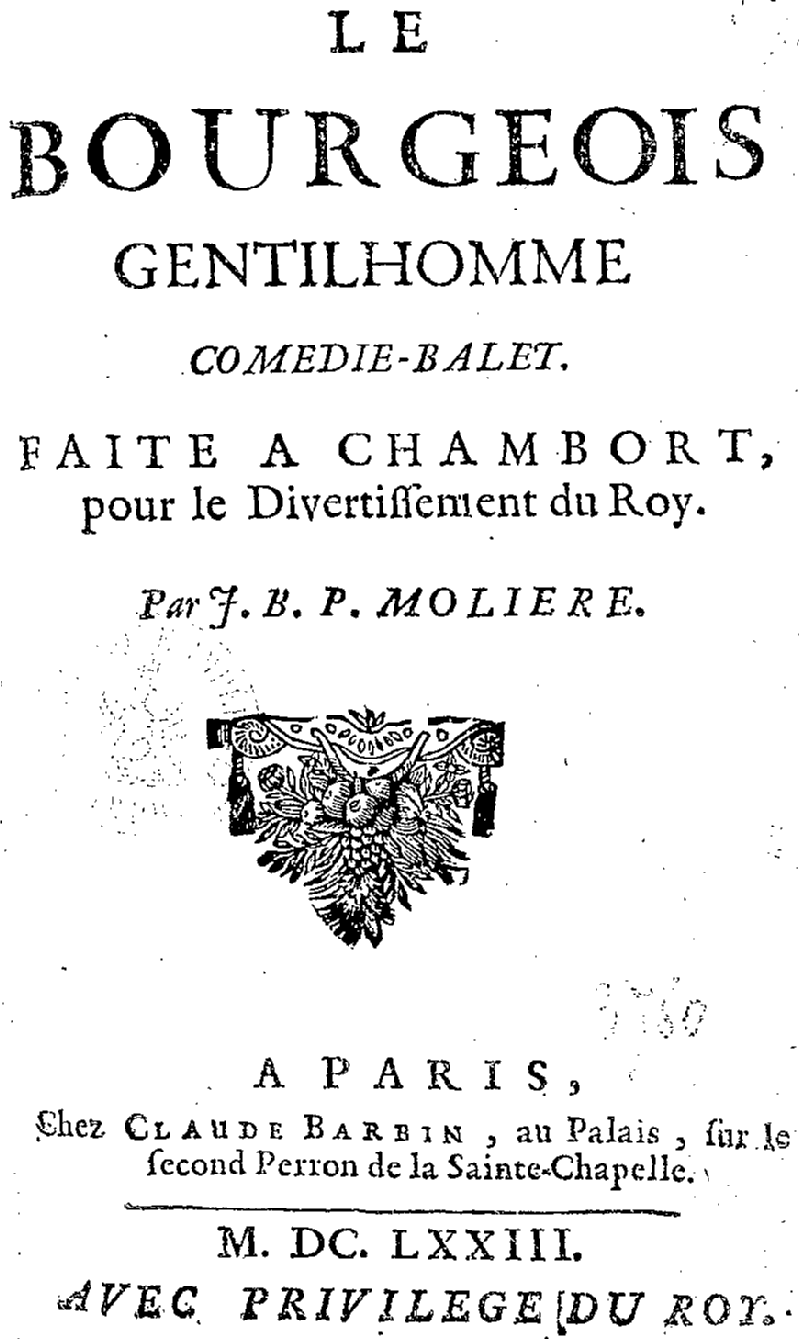
Molière, another genius of both literature and observation, lampoons the would-be aristocrat bourgeois striver in his comedy Le Bourgeois gentilhomme. What Molière perceived is that this is in most cases impossible, because gentlemanly qualities, even regardless of genetic component, must be instilled from birth. And therefore the best he can do is a grotesque caricature.
The aristocrat not only does not feel threatened by the common man, but in fact he feels he has a religious duty to help and support him. This is what is known as noblesse oblige. (And it is very much a religious thing: noblesse oblige is absent from the ethos of the Greek or Roman aristocrat.) The bourgeois caricature of noblesse oblige is, of course, liberal politics (and, in our day and age, “NGOs” and what the British call “Quangos”). What this caricature misses is that noblesse oblige, descended as it is from the ancient feudal order, necessarily involves an element of interpersonal obligation. Noblesse oblige is not, cannot be rendered in the abstract. Even the King, in the traditional understanding, is personally bound to his subjects each individually through a vast pyramid of interpersonal obligations, from King to Prince, Prince to Duke, Duke to Baron, Baron to Merchant Guild, Merchant Guild to Peasant. This is also related to the military roots of the aristocracy: we know that every great military leader, from Alexander to Napoleon, felt a personal duty of care to, and a sense of brotherhood with, every soldier under his command, even though he may not know every soldier personally, even though he necessarily stands atop a necessarily unequal hierarchy of command.
From Noblesse Oblige To Telescopic Philanthropy
Because, again, the bourgeois sees ordinary people as a threat (and because he has usually not experienced this sense of brotherhood through military service—it’s no coincidence that military service is historically the preferred way for ordinary people to join the aristocracy), he cannot develop this sense of interpersonal obligation.

Thus we end up with Stendhal’s bourgeois who treats his servant like dirt while delivering lectures about universal human brotherhood. We end up with the “telescopic philanthropy” of Dickens’ Mrs. Jellyby. Rousseau’s observation that “many a philosopher will say he loves the Tatar, so as not to have to love his neighbor.” Or CS Lewis in The Screwtape Letters: “Do what you will, there is going to be some benevolence, as well as some malice, in your patient’s soul. The great thing is to direct the malice to his immediate neighbours whom he meets every day and to thrust his benevolence out to the remote circumference, to people he does not know. The malice thus becomes wholly real and the benevolence largely imaginary.” These are all observations about bourgeois society.
This is where this phenomenon of the aristocratic caricature becomes most undeniable, because today it is actually quite frequent for rich American heirs to describe their NGO philanthropy as “noblesse oblige.”
In the little patch of Burgundy where I am from, tourists can visit the Hôtel-Dieu de Tonnerre, which still stands today as a priceless architectural monument. This is a hospital founded in the 13th century by my (distant) ancestor Marguerite de Bourgogne, Countess of Tonnerre and Queen of Jerusalem. The hospital treated all sick free of charge, and Marguerite designed the building so that the chapel and the common room would be the same room, to highlight that bodily and spiritual care go hand-in-hand. Marguerite personally oversaw the management of the hospital, endowing it with her own lands to ensure its financial security, and did daily rounds, personally feeding, washing, and caring for the sick poor. An apothecary workshop where various treatments were tried and experimented upon empirically provided medical research within the best abilities of 13th century Europe. Per her will, Marguerite was buried, and remains, under the chapel. The Hotel-Dieu provided free medical care to the poor continuously for centuries until it was shut down by…the French Revolution, that great bourgeois liberal demonstration of the fruits of the Cult of Reason and the Universal Brotherhood of Man3.
So, yes, compared to this, grants to the Indigenous Lesbians of Bongo-Bongo is a grotesque caricature.
The Political Consequences Of The Bourgeois Caricature
There are countless political consequences of the phenomenon I have described. It easily explains a phenomenon that so often puzzles political commentators, which is why so many successful populist leaders with that ineffable “common touch” seem to be wealthy aristocrats of one sort or another, like Donald Trump or Boris Johnson or, it might be hard to believe but this is how he was understood by many at the time, George W. Bush.
The theme of the alliance between the aristocrats and the common people against corrupt mercantile elites is a recurring one in Western societies, from Julius Cesar to Donald J. Trump. (And even this has its bourgeois caricature: the rich failson leading an ideologically left-wing movement.)
It’s mostly forgotten today, but a key political issue in Cesar’s day was…immigration, as rich Roman landowners imported foreign slaves to work their property, driving small landholders to bankruptcy. In fact this phenomenon is so common—a corrupt rich class importing foreign laborers as an economic and political base while immiserating their own middle and working class—that Aristotle describes in the Politics as the normal functioning of tyrannies.
The other way in which a corrupt mercantile elite counters this alliance of the aristocracy with the common people is through much more straightforward alliance with foreign interests. Another reason why the Senatorial class in Rome was despised was because they openly took bribes from Roman client states and even enemies to influence foreign policy (of course, this is all ancient history and never happens today). Mr Rees-Mogg’s wealth comes from finance, and so his interest is in the globalized world; Britain has no interest in Ukraine, but the United States does; calling for ordinary Britons to die in Ukraine is not in the interests of Britain but it is in the interest of a foreign country. And so, again, we see that Mr. Rees-Mogg’s words make no sense as coming from an aristocrat but are perfectly comprehensible as coming from a member of the striver bourgeoisie.
Aristocracy Is Of The Soul
I’ll end with some clarifications. The most important one is that, as I have said, aristocracy is fundamentally a quality of the soul. I don’t know any aristocrat who would deny that there are many who are born into aristocracy and who do not have that quality, and many who are not born into it who are aristocrats of the soul and should be recognized as such—and this is not some concession to modernity, but rather part of the aristocracy’s self-understanding from time immemorial.
After his brilliant victory at the Battle of Marignan, King Francis I of France held a public ceremony where he had himself knighted by his most brilliant commander, the Lord of Bayard, the “knight without fear or reproach.” Of course, no King of France needs to be knighted: he is a knight by birth. But it was a public demonstration of the idea that knighthood must be won or ratified through valor on the battlefield, and by extension through expression of the aristocratic virtues.
Since I’ve already criticized meritocracy, I will note one interesting historical fact: the process that started what would eventually become the French Revolution was King Louis XVI launching what we would now call a public consultation, inviting all communities in France to write him letters, “lettres de doléance,” outlining what they thought was the problems with the Kingdom and suggesting reforms. These lettres make for bracing reading because they paint a picture of an immiserated country oppressed by a corrupt, grasping, do-nothing aristocracy. Nobody denies that pre-revolutionary France was a nation in deep need of reform, but Taine shows that in most localities the “lettres de doléance” process was hijacked by local liberals and were in fact mostly propaganda (today we would call this a psyop); one exception was the region of Brittany, where the body of bourgeois of Brittany wrote that they did not believe that aristocratic privileges should be curtailed “because we know we can ascend to the aristocracy through merit.”4
Here’s one for political theorists to chew on: aristocracy is good because it’s a meritocracy.
Related to this is that I fully grant that my portrait of the bourgeois and the aristocrat are archetypes, and that we can find in reality many bourgeois who act like aristocrats and many aristocrats who act like bourgeois. But even these types are interesting.
The most despicable type, from my point of view, is the liberal aristocrat. His problem is readily understood: instead of feeling gratitude for the generosity of Providence towards him, he feels guilt. And as a result, he is afflicted by the same status anxiety complex as the bourgeois and therefore pursues the same kind of life ethos and politics, usually with a higher dose of virtue signaling driven by a pathetic need to show he’s one of the good ones. Many many such cases, as we say.
The type of the bourgeois who actually succeeds in becoming an aristocrat is more interesting, and here we have two brilliant types.
First is Cicero, who was a commoner, and a meritocratic striver: he became rich and famous as a brilliant lawyer. He allied himself with the party of the aristocracy. In fact he was so consumed by his admiration for the aristocracy that he moved their Optimates party away from sensible reforms that could potentially have avoided their doom.
One potential consequence of the bourgeois’ looking at the aristocracy from outside is the contempt/caricature complex I’ve described; another one is this kind of boundless admiration. Familiarity doesn’t necessarily breed contempt, but it does afford a kind of necessary distance. I’m reminded of a comment someone made about M*A*S*H, the most successful TV show in US history: because it aired at a time when most Americans had served in the military in some capacity via the draft, these Americans, while no doubt being patriotic respectors of the military, could nevertheless enjoy a show that made fun of its bureaucratic foibles and the many small absurdities that make the salt of actual ordinary military life. By contrast, now that the US military has professionalized, popular media about the military has this mythic, over-the-top quality.
Here the contrast with Cesar is instructive. Cesar was an aristocrat’s aristocrat, descended from the Gens Iulia, one of the most august and ancient lines; however, because his family was relatively impecunious, it was not afforded by its fellow aristocrats the kind of status and recognition that, in theory, they should have on account of its lineage. Thus, because he knew the aristocracy from the inside, he had a much more jaundiced, more realistic, view of that world, than the outsider Cicero.
So it’s an interesting counter-example of what I’ve been saying: the bourgeois striver who adores the aristocracy, but thereby is led to doom; the aristocrat who is anti-aristocrat, but in a way that was ultimately supremely aristocratic (becoming King through superior military and political qualities, in an alliance with ordinary people).
Another type of the pro-aristocracy bourgeois, whom I should mention here because I’ve already slagged him somewhat unfairly, is Benjamin Disraeli. Disraeli’s legacy as prime minister is mixed, yes, but it’s impossible not to appreciate him. Like Cicero, he was an outsider striver who became famous as a kind of troublemaker with great rhetorical gifts, before becoming an unlikely leader of the aristocratic party. He turned the phenomenon I have mentioned, of the alliance between the aristocracy and the common people against a corrupt globalized mercantile elite, into a theory, even though he could not quite implement the practice. And he really was an aristocrat of the soul5, a true aristocrat—Queen Victoria, who adored him more than any other politician she had to deal with, certainly thought so, and she would certainly be the expert on this matter.
The fact that aristocracy and bourgeoisie are fundamentally qualities of the soul also help us reckon with a figure like Donald J. Trump. You can make a good argument that Trump is a fundamentally bourgeois figure: a New York businessman! But I think now he is certainly much better understood as an aristocrat: someone who inherited his wealth and status, and someone who feels a much stronger connection and duty towards the common people of America than to his social class.
If not earlier, Donald J. Trump definitively won his knighthood at Butler, PA in July 2024, when he rose up after being shot, not knowing whether there might be more shots coming, aware of the possibility that he might be making his last act on Earth, and lifted up his fist, and shouted to his supporters—his liegemen—“Fight! Fight!”
Two more illuminating points about Donald J. Trump.
First, the importance of interpersonal connection. There’s a famous Reddit thread, dating to when Tump was only just rumored to be preparing a Presidential run, full of countless anecdotes of random people meeting Trump and his unfailing interpersonal graciousness, including many anecdotes of him going out of his way to help random people. Much has been said about how vicious Trump can be to political enemies, but this is also a dimension of the man, and this is the precise opposite of bourgeois telescopic philanthropy, or in the words of another ur-aristocrat, Sulla: no better friend to his friends, no worse enemy to his enemies. Obviously I can’t prove it, but I firmly believe that the reason why Trump is Trump is because, deep in his bones, he has the sense of the people he represents as real people of flesh and blood to whom he is personally bound, even as he hosts a black tie dinner at Mar-a-Lago.
Second, Trump is an aristocrat, but also, famously, an outsider, a bridge-and-tunnel guy who was never fully recognized by and included by the Manhattan aristocracy. Trump is and was a member of the aristocracy, but inside the aristocracy, he is an outsider. As many historians have noted, world-historical leaders often have this quality: I have mentioned Cesar; the other obvious example is Napoleon, who, while an aristocrat, as a minor Corsican gentleman, was nevertheless considered an outsider within the French aristocracy.
And So…
And so is the sad reality: few people have spent as much energy in trying to be an aristocrat in every way as the highly intelligent and talented Mr Rees-Mogg, and yet all he can accomplish is a crude caricature, one at times ridiculous and at times sinister.
And this phenomenon, far from being an idiosyncracy, has been one of the quiet but powerful driving forces of the history of the West since the 18th century.
SEE ALSO:
The French Aristocracy's Secret Selective Breeding Project
A very interesting phenomenon happened a few weeks ago: an obscure doctoral thesis in philosophy, self-published by its author, one Costin Alamariu, went viral and became a best-seller on Amazon.
Modern historians almost universally assume Napoleon to be a fundamentally revolutionary, modern figure. Pro-Napoleon historians because they see these things as good; anti-Napoleon historians (especially in the Anglosphere) because they want to associate him with the excesses of the Revolution, making him a kind of Robespierre 2.0 (“Do you want to see a guillotine in Piccadilly, boys?” as if a Napoleon who had conquered Britain would have launched an orgy of mass murder instead of giving them better laws and administration like he did Germany and Italy). You could just as easily see him as a Ancien régime figure who sought to update and modernize the Ancien régime, but fundamentally maintain it and extend it. His creation of the Empire is often explained away as a kind of sad fit of megalomania brought on by too much power and too many victories; however, there’s no sign of Napoleon changing his temperament in this way before the Empire, and as Andrew Roberts shows, it is clear that he prepared and intended the restoration of monarchy from the first minute of his consulate. Food for thought…
I also have two surnames on my passport but only use one—my culture is not your costume, Mr. Rees-Mogg.
Among many other depredations, the French Revolution was a disaster for the actually-existing poor people of France in the period; prior to the Revolution, France had actually a quite comprehensive and developed, certainly for the time, network of social welfare institutions, which were supported by a combination of private and public subsidies as well as land-based endowments. These institutions, however, were all run by Church organizations, and so the revolutionaries shut them all down and stole all the land. At the time the revolutionaries proudly claimed they would replace it with a much superior state-managed system of social welfare, which naturally never materialized in spite of a series of half-baked bureaucratic schemes that make for a darkly comical tale.
More humorously, a French duchess writing of the need for the aristocracy to regularly bring in new blood: “Every once in a while, even the most beautiful flower must be fertilized by manure.”
For me personally, it’s hard not to connect this to Disraeli’s Jewish heritage. The groypers who tally up the number of prominent Jews in the American left as evidence of Jews being a subversive influence are mixing up cause and effect. What this shows, rather, is Jews’ prodigious ability to assimilate into a nation’s elite, and in post-New Deal America, this meant assimilating into a WASP elite that had been ideologically progressive for generations before Jews became influential in America. This much better explains, for example, why Jews were also disproportionately represented in Mussolini’s Fascist Party even before Mussolini rose to power.
Brilliant piece. The times I have met and dealt with actual aristocrats it has been noticeable how unpretentious they are. As you say, they are often much more in tune with what the common man actually thinks and wants than credentialed middle class strivers tend to be. But that is of course another benefit of having a low time preference and taking the long view rather than merely looking to the next election cycle.
A) Rees-Mogg was knighted in 2022, so he is Sir Jacob, not "Mr Rees-Mogg". B) He is the son of a peer but not (yet) a peer himself.